

COMMITTED TO THE ERADICATION OF CSEC IN TOURISM
At Destinos Del Perú, we are fully committed to the Code of Conduct against the Commercial Sexual Exploitation of Children (CSEC) because we understand that providing high-quality and reliable tourism services not only means exceeding our clients’ expectations but also acting with social responsibility and sustainability in every destination where we operate.
In accordance with Law No. 28251 and the national policy promoted by MINCETUR, we have established transparent and responsible standards of conduct to prevent, reject, and denounce any form of commercial sexual exploitation of children that could be associated with the tourism services we provide. In this way, we actively contribute to our sector’s efforts in the fight against this crime and reaffirm our commitment to ethical, safe, and dignified tourism that respects human dignity.
CONTEXT OF CSEC IN PERU AND TOURISM
In Peru, the Commercial Sexual Exploitation of Children (CSEC) remains a persistent social problem. In 2024, 1,762 victims of crimes against human dignity were registered, of which 692 were minors (39.3%). In the Loreto region, of the 126 victims identified, almost 70% were girls, boys, and adolescents.
CSEC is a social problem that can affect various sectors, including tourism. Therefore, companies, authorities, communities, and travelers share the responsibility of ensuring that tourism in Peru is safe, ethical, and beneficial for all.
OUR DUTIES AND COMMITMENTS UNDER THE CSEC CODE OF CONDUCT
✔ Not promote or permit CSEC within our services, maintaining a strict policy of rejection against any form of sexual exploitation carried out by national or foreign tourists, other service providers, or any person linked to our company.
✔ Refrain from offering in our programs, tours, and/or services – explicitly or implicitly – any situation related to CSEC, as well as directing tourists, whether directly or through third parties, to establishments or places where CSEC occurs.
✔ Develop workshops, provide information, and train our professional team, as well as any person or institution involved in our activities, on the laws, regulations, internal policies, manuals, and other prevention measures related to CSEC.
✔ Disseminate informational material on CSEC prevention to our clients and any interested person.
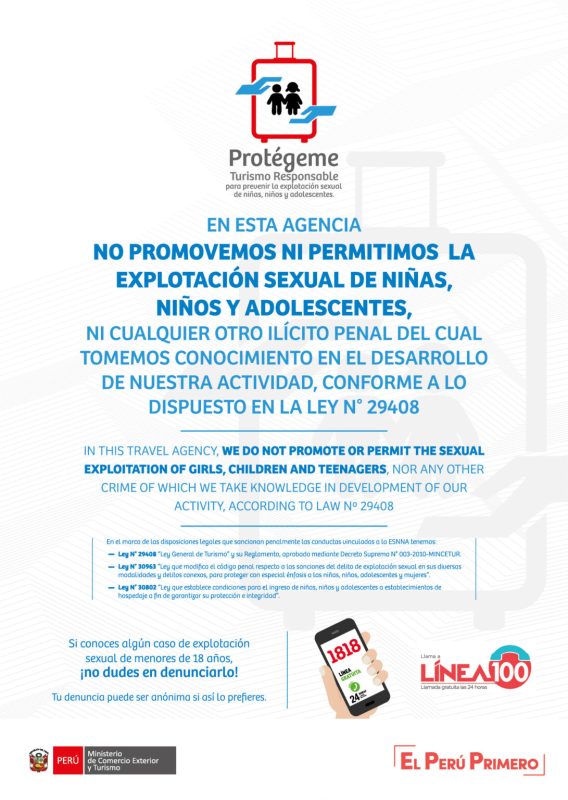
✔ Maintain visible symbols that inform clients and providers about our stance against the sexual exploitation of children in tourism and travel.
✔ Immediately report to the competent authorities any act related to CSEC that we become aware of in connection with the offering or provision of our services.
✔ Include a clause in our contracts with tourism service providers declaring our shared rejection of CSEC. The following statement will be used: “Tourism promotes a childhood and adolescence free from sexual exploitation. Therefore, we do not accept any act that encourages or tolerates the sexual exploitation of children and adolescents.”
✔ Fully comply with all provisions established in the CSEC Code for the tourism sector.